
Roof Repair That Fixes the Leak, Not the Symptom
We repair roof leaks across Central Texas. Most of them turn out to be a flashing or penetration problem rather than a failing roof, which means a repair rather than a replacement. We find the source, photograph it, and tell you what it will take to stop it.
Call the main line at (512) 584-3843, or ask us for a free written quote. Cedar Park at (512) 566-5510 and Round Rock at (512) 566-5511 answer around the clock.
A leak almost never appears where the water gets in. Water travels along decking and rafters before it finds a spot to drop, so the stain on your ceiling can be six feet from the actual hole. That’s why the first job is diagnosis, and why an estimate given from the driveway isn’t worth much.
Request a free inspection
How We Find the Leak
We start where leaks actually start: at transitions. Flashing around chimneys, sidewalls, and skylights, valleys where two planes meet, and pipe boots at plumbing penetrations account for most of what we see. The open field of a roof fails far less often than the places where it has to change direction or make room for something.
From the attic side, we look for staining on the decking and rafters, because dry marks tell you where water has been even when it isn’t raining. From the roof side, we check the condition of the surrounding shingles, since a repair only holds if what it’s tied into still has life in it.
You get photographs of what we found. If we can’t find it on the first visit, we say so rather than guess, because a repair in the wrong place is money spent twice.
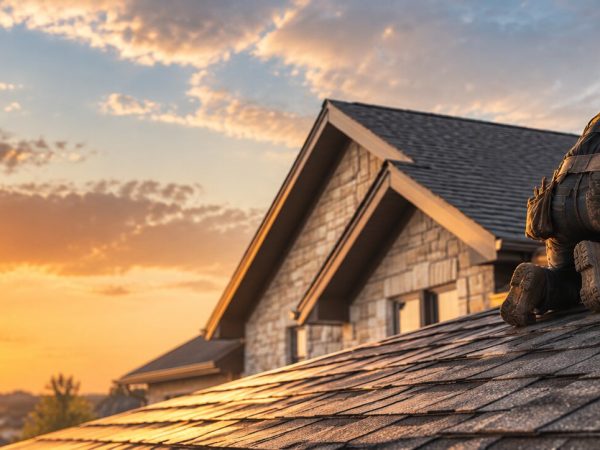

What We Repair
Flashing is the most common repair we do. Metal at a chimney or sidewall can corrode, lift, or be installed too short in the first place, and water finds the gap. Replacing it properly means removing the shingles around it rather than smearing sealant over the top, which is the version that fails again next season.
Pipe boots are the second. The rubber collar around a plumbing vent has a shorter life than the shingles it sits in, and in this climate it cracks well before the roof is done. It’s a small part and a routine fix.
We also handle wind-lifted and missing shingles, damaged or displaced valley metal, ridge and hip repairs, and localized decking replacement where water has already softened the wood underneath. Storm-damage work is handled as its own job, with its own documentation.
When a Repair Stops Making Sense
We’ll tell you when repairing is the wrong call. If a roof is shedding granules across every slope, curling at the edges, or on original shingles past twenty years, patching one spot buys you months rather than years. At that point, a full replacement is the cheaper decision even though it’s the bigger invoice.
Matching is the other limit. Shingles weather, and a repair on an older roof will be visible even when the color code is right. We’ll be upfront about how noticeable it will look before you commit, not after.
If you’d rather know where you stand before anything leaks, we’d start with an inspection first.
Where We Work
We repair roofs throughout Williamson County and the northern Austin metro, working from three locations.

Cedar Park homeowners are covered from our Cedar Park base, which handles the Whitestone and Lakeline corridors.
Round Rock homeowners are covered from the Round Rock listing, which runs around the clock the same way the Cedar Park line does.

Austin repairs run from the Balcones Club Drive location on the northwest side. We also work in Georgetown, Leander, and the communities in between, across Central Texas.
Fourteen years of roofs in this market, fully insured, and thirty-eight reviews across our three listings. You’ll get the workmanship warranty and the manufacturer’s coverage in writing. If you want to know more about the people doing the work, ask or message us directly.
Frequently Asked Questions
How much does roof repair cost in Central Texas?
It depends on what’s failing and how much of the surrounding roof has to come up to fix it properly. A pipe boot is a small job. Flashing at a chimney is bigger because we have to remove and reset shingles. We quote in writing after we’ve found the problem, and our guide to the cost of a new roof covers where repair stops being the economical choice.
Can you repair a roof without replacing the whole thing?
Usually, yes. Most leaks are localized failures at a transition, not a roof that’s given up. What matters is whether the shingles around the repair still have life in them, because a patch tied into brittle material doesn’t hold. We’ll tell you what you’re dealing with before we start.
How long does a roof repair take?
Most repairs are a few hours. Repairs that need decking replaced, or involve a chimney or skylight, can take most of a day. Weather moves things more than the work does. We’ll give you a realistic window, not an optimistic one.
How do I know where my roof is leaking?
You usually can’t tell from inside. Water runs along decking and rafters before it drops, so the ceiling stain is rarely under the entry point. Attic staining patterns and the condition of the flashing tell us far more than the drip location does.
Do you repair roofs after a storm?
Yes, though storm damage is its own process because documentation matters if an insurer is involved. We photograph what’s there and give you our read on whether it warrants a claim. Not every storm leaves damage worth filing a claim for.
Is a leaking roof an emergency?
Active water coming into the house is worth calling about immediately, and both our listings answer around the clock. A stain that’s been there a while is less urgent, but it shouldn’t wait for the next storm, because the decking underneath gets worse the whole time.
Will a repair void my roof warranty?
A repair done correctly by a roofing contractor generally doesn’t affect a manufacturer’s shingle warranty, but the specifics depend on the product and who installed the roof originally. Tell us what coverage you have, and we’ll work within it rather than around it.